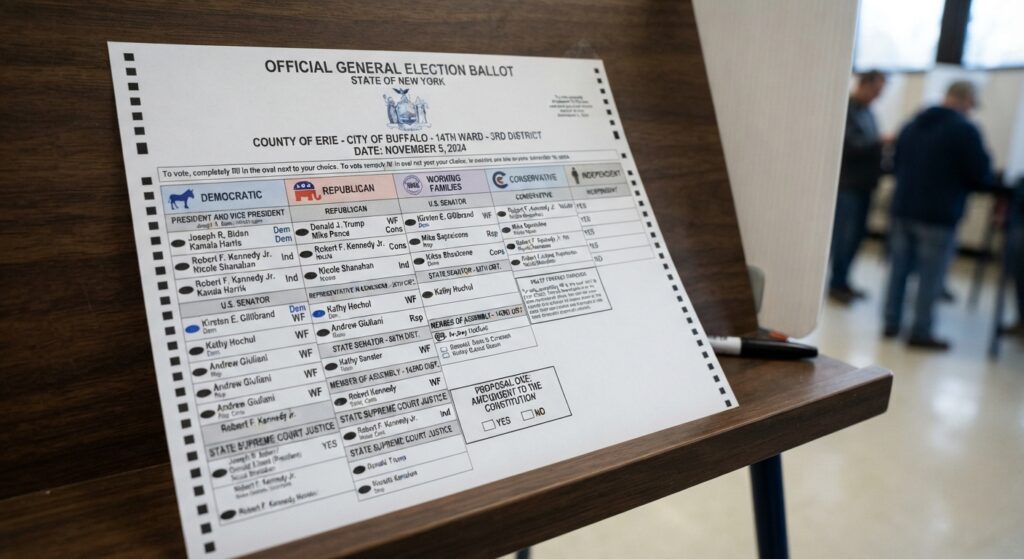
Ballot access in New York State refers to the legal requirements and procedures that political parties and individual candidates must meet to have their names printed on election ballots.
Candidate Ballot Access Requirements
Candidates may appear on the ballot either through party designation or by running as independent or unaffiliated candidates.
- Ballot-Qualified Party Candidates: Candidates in primary elections for recognized parties must collect the required number of petition signatures from registered party members or meet office-specific thresholds. For example, State Assembly candidates need 500 signatures, with higher requirements for federal and statewide offices.
- Independent/Unaffiliated Candidates: Those not affiliated with a qualified party must submit independent nominating petitions. Statewide and major federal independent candidates must meet high signature requirements, such as 45,000 signatures or a percentage of the previous gubernatorial vote. Advocacy groups note these are among the highest thresholds in the nation.
Political Party Ballot Status
To gain and keep automatic ballot access as a recognized political party in New York, an organization must meet specific electoral thresholds:
- Maintenance Threshold: A political party must field a candidate for governor or president who secures at least 2% of the total vote or 130,000 votes (whichever is greater) during every gubernatorial or presidential election cycle.
- Current Qualified Parties: Parties that meet these criteria retain automatic status. They must also officially register party rules, local committee structures, and filing obligations with the state.
The New York State Board of Elections maintains official forms, deadlines, and candidate handbooks.
Additional Information on Ballot Access Laws in New York
Ballot access laws in New York establish the legal requirements for political parties and candidates to appear on official election ballots. Known for being among the most rigorous and debated in the United States, these regulations influence election outcomes and affect the ability of minor parties and independent candidates to compete with major parties.
To maintain automatic ballot status, established parties must secure at least 130,000 votes or 2% of the total votes cast in the previous gubernatorial or presidential election, whichever is greater. If a party does not meet this threshold, it loses automatic status and must restart the petitioning process for future elections.
Independent and statewide candidates must meet significant petition signature quotas to appear on the ballot. Statewide candidates need at least 45,000 valid signatures, with a minimum of 500 signatures from at least half of New York’s congressional districts. This rule ensures candidates have broad regional support rather than relying solely on urban areas.
Supporters of strict ballot access laws argue that high thresholds prevent administrative gridlock, reduce voter confusion from crowded ballots, and ensure only serious campaigns with organizational support appear on the ballot. They believe signature requirements test a campaign’s viability and grassroots strength.
Critics and reform groups view New York’s requirements as exclusionary barriers that protect incumbents and limit competition. Independent and third-party advocates note that signature requirements impose significant financial and logistical burdens, often necessitating the use of costly paid signature-gatherers. They argue these barriers reduce voter choice, discourage participation, and underrepresent alternative perspectives.
Legal challenges often target these provisions, with plaintiffs claiming that restrictive rules violate constitutional rights to free speech and association under the First and Fourteenth Amendments. New York remains a central focus for election law reform, balancing orderly election administration with open political competition. The New York State Board of Elections portal provides comprehensive guidelines and updates.